Guiding Pilgrims with Confidence
St James the Apostle
St James, one of the Twelve Apostles, was among Christ’s earliest followers. After the Resurrection, tradition says he travelled west to preach in Iberia. Returning to Jerusalem, he was executed in 44 AD, becoming the first martyred apostle. His disciples carried his remains by sea to Galicia, landing near present‑day Padrón. Centuries later, in the 9th century, a hermit named Pelayo reported a miraculous light over a field.
Bishop Teodomiro declared the site the tomb of St James, and Santiago de Compostela was born. Medieval Europe soon turned westward, creating one of Christianity’s great pilgrimages. Kings, knights, monks, and ordinary travellers walked to seek protection and forgiveness. The scallop shell became his emblem, marking the routes that converged on his shrine. Today, St James’s legacy endures through the Camino — a path shaped by faith, culture, and centuries of devotion.
The Camino History
The Camino began in the 9th century after the reported discovery of St James’s tomb in Galicia. Word spread quickly, drawing pilgrims from across medieval Europe toward Santiago.
Routes formed naturally as travellers walked from their own towns, creating many Caminos, one destination. Monasteries, hospitals, and bridges were built to support the growing flow of pilgrims. By the Middle Ages, it became one of Christianity’s most important journeys.
The scallop shell emerged as its symbol, marking the way across fields, coasts, and cities. Pilgrims walked for faith, forgiveness, protection, or simple human hope. The tradition survived wars, plagues, and political upheaval, always returning stronger. A modern revival in the late 20th century brought millions back to the path. Today, the Camino blends history, culture, landscape, and meaning into a single, living journey.
The Compostela
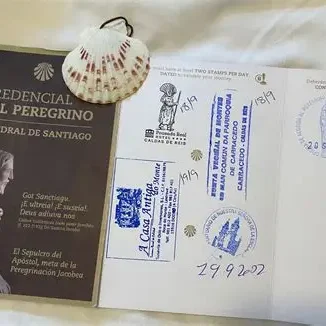
The pilgrim credential is the official Camino passport used to collect stamps along the route. It serves as proof of your journey and is required to receive the Compostela in Santiago.
Each page contains six boxes where albergues, cafés, churches, and municipal offices place their sello. Pilgrims usually collect two stamps per day during the final 100 km to validate their walk.
Your personal details and starting point are written inside when the credential is issued. On arrival in Santiago, the Pilgrim’s Office adds the final official stamp and checks the completed pages.